
3-on-6 vs All-on-4 vs All-on-6: Understanding the Differences
Compare 3-on-6, All-on-4 and All-on-6 dental implants: bridge designs, assessment, treatment stages, maintenance and quote questions for UK and Irish patients.
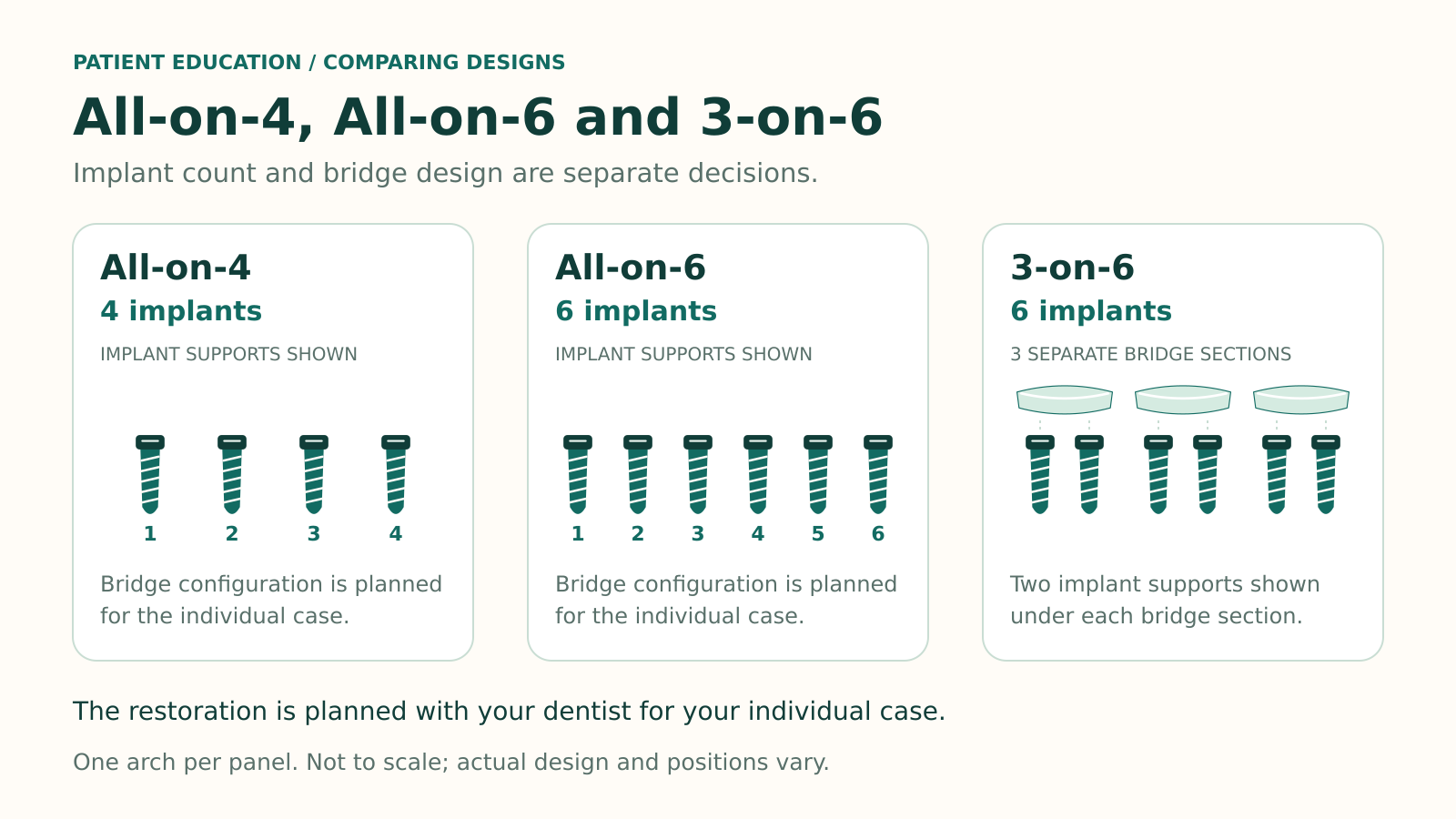
One arch per panel. Not to scale; actual design and positions vary.
When you compare full-arch dental implants in Turkey , the names can make the decision look like a choice between numbers. A more useful comparison asks two questions: how many implants support the replacement teeth, and how are those teeth designed? Keep those questions separate when discussing options for treatment in Antalya.
For patients travelling from the UK or Ireland, a clear explanation should also cover the temporary teeth, the final restoration, the visits and the care needed afterwards. Start with the proposed treatment for your mouth, then compare the quotation.
What do the three names mean?
| Term | Implant support in one treated arch | What it tells you about the restoration |
|---|---|---|
| 3-on-6 | Six implants | Three separate bridge sections. [1] |
| All-on-4 | Four implants | A fixed full-arch restoration. [9] |
| All-on-6 | Six implants | The name identifies implant number; the proposed bridge layout still needs clarification. [3] |
The 3-on-6 description comes from its originating provider's terminology. It refers to one jaw, rather than six implants divided between the upper and lower jaws. [1]
Nobel Biocare describes the All-on-4 concept as four implants supporting a full-arch restoration, with temporary and final restorative stages. [9] The name alone does not establish which stage a particular advertised price includes.
Why All-on-6 and 3-on-6 can overlap
Six implants may support one-piece or segmented bridgework. The proposed layout therefore needs to be stated explicitly. [3]
Ask the dentist to sketch the design on your own treatment diagram. Where do the bridge sections begin and end? Which components support them? How would the restoration be maintained? These questions help reveal the actual differences between two proposals that otherwise sound similar.
You can explore the layout in more detail in our 3-on-6 dental implants guide , or read about All-on-4 and All-on-6 separately.
More implants do not settle the decision
The final restoration, available anatomy, implant positions, opposing teeth and cleaning access inform the design. [3]
Read the clinical explanation beside the treatment diagram. It should identify the finding that led to the recommendation and explain which alternatives were considered. This is where the comparison becomes specific to you: the same treatment name on two proposals does not explain why each was recommended.
A useful consultation leaves you able to explain the recommendation in your own words. If all you can recall is the package name, ask the team to go through the reasoning again.
Bone grafting and the treatment sequence
Where insufficient bone is available for the planned implants, grafting may be required. That can add surgery and healing time. [6] None of these labels can answer the grafting question for an individual patient.
Ask for additional procedures to be shown separately in the treatment schedule. If a second opinion suggests a different sequence, compare the explanation for that difference before comparing totals. Keep a written record of the questions still awaiting an answer.
What are the final teeth made from?
Zirconia is a ceramic used for some implant-supported restorations. Choosing that restorative material involves design and space considerations; it does not identify the material of the implants beneath it. [8]
For example, “titanium implants with a zirconia bridge” names two distinct parts of a proposal. Ask for both to be recorded clearly. Also ask whether the final restoration differs from the temporary teeth in material, shape or maintenance requirements. Compare the complete specification rather than a single material label.
Temporary teeth and final bridges are different stages
Immediate loading requires clinical selection and adequate implant stability. ITI guidance does not make it an automatic consequence of choosing four or six implants. [4]
Have the temporary restoration described separately from the final teeth. The proposed sequence should explain what you would wear during healing, the appointments before fitting the final restoration and what would change if the original plan needed to be revised. Those details give you a useful basis for discussing visits with the clinic.
Fixed teeth still need a maintenance plan
A fixed bridge is attached to the implants and is not removed by the patient for everyday cleaning. [5] Fixed treatment still needs ongoing home care and professional maintenance; ACP guidance recommends an individually planned routine for restored teeth. [7]
Ask to be shown the cleaning method for the proposed design. Discuss who will provide routine reviews after you return home and who will handle a restoration problem. Have the maintenance instructions available to share with your local dentist, rather than relying on a package description.
Implant treatment has risks, including infection, implant failure, nerve injury and component loosening. Your dentist should explain the risks relevant to you and how a problem would be managed. [2]
Compare the work described in each quote
If one estimate names the final bridge and another mentions only the implants, first establish whether both include the same restoration. Do the same for temporary teeth and later fitting appointments. Until those details are clear, the totals may describe different scopes of work.
Use our itemised cost guide alongside the treatment price page to compare the written inclusions. For travel organisation, the Antalya planning guide covers scheduling, records and follow-up arrangements.
Discuss your next step in Antalya
Whether you are exploring 3-on-6, All-on-4 or All-on-6, start with a clear list of what you want to understand. Book a free online information meeting with an International Patient Coordinator at Amazing Smile Turkey. You can discuss visiting Antalya, the information to prepare and how clinical appointments are organised. Keep your questions about suitability and the final design ready for the dentist who assesses you.
Sources
1. Utah Smile Clinic: 3-on-6 terminology https://www.utahsmileclinic.com/learn-more-3-on-6
2. FDA: Dental implants https://www.fda.gov/medical-devices/dental-devices/dental-implants-what-you-should-know
3. ITI: Implant numbers and prosthesis design https://academy.iti.org/academy/consensus-database/consensus-statement/-/consensus/number-of-implants-placed-for-complete-arch-fixed-prostheses/1701
4. ITI: Loading protocols https://academy.iti.org/academy/consensus-database/consensus-statement/-/consensus/loading-protocols-for-fixed-prostheses-in-edentulous-jaws/1313
5. Leeds Teaching Hospitals: Dental implants https://www.leedsth.nhs.uk/patients/resources/dental-implants/
6. Guy’s and St Thomas’: Bone grafting https://www.guysandstthomas.nhs.uk/health-information/bone-grafting-dental-implants
7. ACP: Caring for restored teeth https://www.gotoapro.org/caring-for-restored-teeth-faq/
8. ITI: Zirconia full-arch restorations https://blog.iti.org/clinical-insights/10-considerations-on-the-use-o-monolithic-zirconia-for-one-piece-implant-supported-fixed-complete-dental-prostheses/
9. Nobel Biocare: All-on-4 terminology https://www.nobelbiocare.com/en-us/find-all-on-4-center
Sources 1 and 9 define names and layouts. They are not used to rank treatments or endorse a clinic.
Related treatment information
Explore the related treatment guide ↗
